September 8, 2026
Pool Fence Requirements in New Jersey
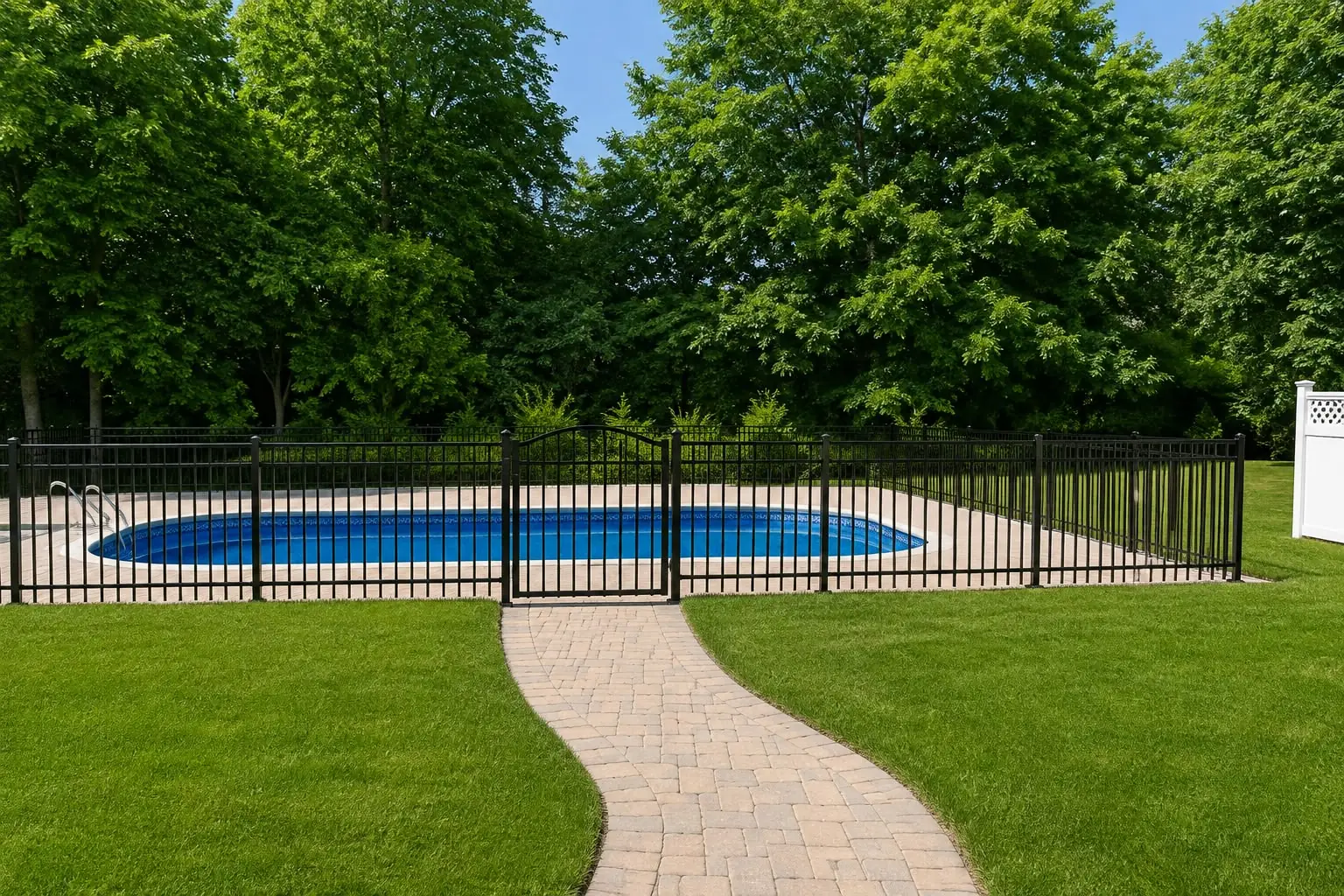
A pool fence is the one fence where the rules are not a matter of taste. New Jersey has adopted requirements for residential pool barriers, your town's construction office inspects against them, and a pool cannot legally be used until the barrier passes.
Here is what those requirements actually say, in plain terms.
The barrier itself
**At least 48 inches high**, measured on the outside — the side a child would approach from. If your ground slopes away from the pool, the fence has to be tall enough at the lowest point, not the highest.
**No gap a 4-inch sphere passes through.** That covers the spacing between pickets, the gap between rails, and anywhere the fence meets a wall or a post. It is why ornamental aluminum for pools has closer picket spacing than the same fence sold for a front garden.
**No more than 2 inches of clearance at the ground.** Enough to mow under, not enough to crawl under.
**Nothing climbable on the outside.** Horizontal rails within reach on the approach side are a ladder. This is the requirement that most often rules out a fence someone has already bought.
Gates
Gates are where inspections are failed, and they are the part that degrades over time.
- **Self-closing.** It must swing shut on its own from any position, not just from nearly closed.
- **Self-latching.** It must latch without anyone touching it.
- **Opening away from the pool**, so a child pushing against it closes it rather than opens it.
- **Latch out of reach** — at least 54 inches from the ground, or shielded so a hand cannot reach through the fence to release it.
A gate that self-closes on the day of inspection and sags six months later is no longer compliant. Hinges are worth spending money on.
If the house forms part of the barrier
Where a wall of the house makes up one side of the enclosure, every door leading from the house to the pool area needs an audible alarm — one that sounds when the door opens and is loud enough to be heard through the house.
This catches people out on renovations. Moving a pool closer to the house, or adding a door onto the pool side, can pull the house into the barrier and bring the alarm requirement with it.
Your town has the final word
The figures above come from the codes New Jersey has adopted, but municipalities amend them. **Sixty inches instead of forty-eight is common for above-ground pools**, and some towns add their own rules about gate placement or setbacks.
The construction office in your municipality decides, and their interpretation is the one that matters on inspection day. We deal with these offices across Bergen, Passaic, Essex and Hudson County regularly, and we build to the standard your town applies rather than the statewide minimum.
Above-ground pools
An above-ground pool has a barrier built in — the pool wall itself — but only if it is tall enough and the ladder or steps can be removed, locked, or raised out of reach. If there is a deck attached, the deck becomes part of the barrier and needs its own fence and gate.
A word about timing
Pool barrier permits take longer than ordinary fence permits in most towns, because they are inspected rather than just approved. If the pool is going in this summer, start the fence conversation early — the barrier is often the thing that holds up first use.
We install pool-safety aluminum from $48 per linear foot, and we handle the permit and the inspection. The estimate is free and we usually get out within 48 hours.
— Angelo Fence Team